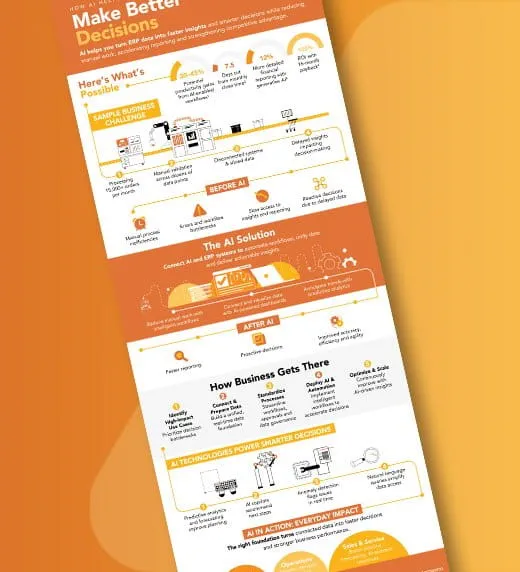
It’s easy to assume reporting challenges are simply part of doing business, but these challenges may be a bigger warning sign that your enterprise application is limiting performance, visibility and growth:
Most finance leaders do not immediately blame their enterprise resource planning (ERP) system when decision-making becomes harder.
Instead, you notice smaller operational frustrations first.
Reports from different departments don’t match. Finance teams spend days validating numbers before leadership meetings. Teams export data into spreadsheets because the ERP cannot provide the reporting they need. The month-end close becomes a scramble. Executives ask simple questions that still require multiple people and multiple systems to answer.
Over time, those frustrations compound into something far more serious:
For many finance leaders, these are not isolated reporting problems. They’re warning signs that your ERP is no longer keeping pace with operational complexity, reporting demands or strategic decision-making needs.
That creates a significant business risk situation. When you lose confidence in your data, the business loses speed, agility and the ability to make informed decisions with certainty.
In our experience, leaders underestimate how much operational drag is created by unreliable or disconnected data.
When teams cannot trust what they are seeing, they stop moving decisively. Decisions get delayed while numbers are manually validated. Departments produce different versions of the truth. Finance has one set of numbers while operations has another. Sales reporting differs from accounting reporting. Leadership meetings become conversations about whose data is correct instead of what actions the business should take.
Finance becomes trapped in reconciliation instead of analysis.
Eventually, the business starts normalizing inefficiency.
Leadership teams begin accepting delays in reporting as “just how things work.” Manual exports become part of standard operations. Spreadsheet workarounds multiply across departments. Finance teams spend more time gathering information than interpreting it.
These are symptoms of systems that are limiting your organization’s ability to operate effectively.
This is especially common if you’re running on legacy ERP systems, disconnected applications or heavily customized environments that weren’t designed for modern reporting and operational visibility.
When left unchecked, those limitations create measurable business risk:
The problem isn’t simply that reporting takes too long. It’s that the business cannot operate confidently when no one fully trusts the information driving decisions.
It’s easy to assume that your spreadsheets are the issue. It’s not. In fact, spreadsheets remain an important analytical tool for many finance teams.
The problem is when spreadsheets become the operational backbone of the organization because your ERP system cannot provide timely, usable or trusted information.
When you rely heavily on manual exports and spreadsheet manipulation to operate, several risks emerge:
More importantly, spreadsheet dependency prevents finance teams from operating strategically.
Instead of delivering forward-looking insights, your teams become trapped in manual data preparation and reconciliation work. This creates a major competitive disadvantage for leaders who are increasingly expected to make faster, data-driven decisions.
Many ERP systems were originally designed for a world where reporting was retrospective, not for real-time or predictive decision-making.
Your teams are often frustrated when traditional ERP environments struggle with (or aren’t’ capable of):
As your organization grows in complexity, those limitations become increasingly visible.
You ask for deeper operational insight, faster close cycles and more dynamic forecasting capabilities. Executives expect immediate visibility into performance metrics. Boards demand greater confidence in reporting accuracy and strategic planning. Private equity firms expect timely, decision-ready visibility into portfolio performance, risk and value creation progress.
But legacy environments can’t support those expectations without significant manual effort. So, your organization unintentionally creates operational bottlenecks around finance and reporting functions.
The result? Your business slows down because the systems supporting it cannot deliver the speed or visibility modern leadership teams require.
A modern ERP environment helps your business operate differently.
Instead of reacting to fragmented information, they work from connected, real-time visibility across the business.
Finance teams spend less time validating data and more time analyzing performance. Leadership teams access dashboards that reflect current operational conditions instead of historical snapshots from days or weeks ago. Departments align around consistent reporting structures and shared metrics.
Most importantly, decision-making becomes faster and more confident because leaders trust the information in front of them.
That often includes:
This shift isn’t just about efficiency. It changes how you operate strategically.
When you trust the data, you can identify risks earlier, respond faster to changing conditions and make decisions with greater confidence.
That creates operational agility that is difficult to achieve with disconnected legacy environments.
So, what’s your next move?
We often see leaders delay ERP modernization because current processes still technically function. After all, reports eventually get produced. Teams find ways to work around system limitations. The business continues to operate.
But operational survival is not the same thing as operational effectiveness.
The longer you normalize disconnected systems and manual reporting processes, the more difficult it becomes to scale efficiently, attract strategic talent and respond quickly to market changes.
You might not understand how much your ERP environment is limiting performance until you see what a modern finance technology ecosystem could provide.
That's why the smartest ERP decisions start with business visibility and confidence rather than software features, shaped by the functional conversations happening long before anyone picks a system.
We hear leaders asking:
Those aren’t just technology questions; they’re business performance questions.
And if this is your reality, here’s your next step.
Not every organization needs to replace its ERP immediately.
But you do need to understand whether your current environment is supporting or limiting strategic decision-making. That evaluation should go beyond technical functionality alone.
You should ask:
You should also evaluate the broader finance technology ecosystem supporting the ERP environment.
In many cases, the challenge is not a single application but an increasingly fragmented technology stack that has evolved without a clear long-term strategy. Building a structured finance technology roadmap is often the first step toward improving visibility, operational efficiency and decision-making confidence. Your ERP is part of that roadmap.
You shouldn’t have to question whether you can trust the numbers. When you do, it creates operational risk that extends far beyond finance.
Because when leadership lacks confidence in the data, every strategic decision becomes harder.
The leaders we see gaining advantage today are not necessarily the ones with the most data. They’re the ones with the clearest, fastest and most trusted visibility into their business operations.
Modern ERP transformation is about creating operational confidence to make better decisions more quickly.
If you’re unsure of whether your ERP is helping you make confident decisions, it may be time to take a closer look at your ERP options. Learn how our ERP experts can help you to informed decisions faster with a system that gives you reliable and actionable data.
To learn more about modernizing your ERP, getting a project back on track or setting your business up for sustainable growth, schedule your complimentary ERP consultation.