
AI-powered enterprise applications are transforming enterprise platforms from transactional systems into intelligent decision-support engines. With this advancement you can:
For decades, enterprise resource planning (ERP) systems primarily served one purpose: record what already happened. You used it to track transactions, manage purchasing, close the books and generate reports. Even with the most advanced past ERP platforms, your team had to sift through the data, interpret it, identify patterns and decide what actions to take.
That model is rapidly changing. With AI, ERP is becoming less of a retrospective reporting tool and more of an active decision-support platform. Today’s ERPs continuously analyze operational and financial data, find insights in real time and help you make faster, more strategic decisions.
The challenges you face today are not operationally simple.
You’re likely managing increasing complexity across entities, supply chains, global operations, compliance requirements and customer expectations. You’re under pressure to move faster while navigating greater uncertainty. Historical reporting alone is not enough to support the new level of decision-making.
AI doesn’t just automate tasks. It fundamentally changes how the business operates.
How? The AI in ERP advancements can help you improve forecasting accuracy, identify risks earlier, enhance operational visibility and make more informed decisions across finance, operations and leadership teams.
If you’re working with a modern ERP, you likely have embedded AI capabilities that you haven’t fully explored. It’s time to put those capabilities to work.
It’s no secret that traditional ERP systems are inherently reactive. They tell you what happened last week, last month, last quarter. You review reports after transactions occur and make decisions based on historical snapshots.
AI fundamentally changes that dynamic.
Instead of functioning solely as a historical reporting tool, AI-enabled ERP systems continuously analyze operational and financial data to identify patterns, exceptions and emerging trends as they happen. This creates a significant shift in how your business operates.
Rather than waiting for month-end reports to uncover margin issues, you can identify anomalies earlier. Instead of manually monitoring operational performance, you can provide leaders with predictive insights that highlight potential disruptions before they impact the business.
The value isn’t just speed; it’s foresight.
AI-powered ERP systems can help you:
An AI-equipped ERP moves past reporting and into active business guidance.
Beyond being just reactive, traditional ERP environments struggle with limited data visibility.
You may still make decisions using outdated information, not just because it’s based on historical data, but because it comes from multiple sources that require time-consuming reconciliation before the data is useful.
This slows down operations.
AI-enabled ERP systems produce relevant data faster by continuously providing business insights in real time. No manual reconciliation required.
This saves you time and allows you to:
The result is better decision-making across your teams. In fast-moving industries, decision speed is a distinct competitive advantage — when it’s based on reliable data.
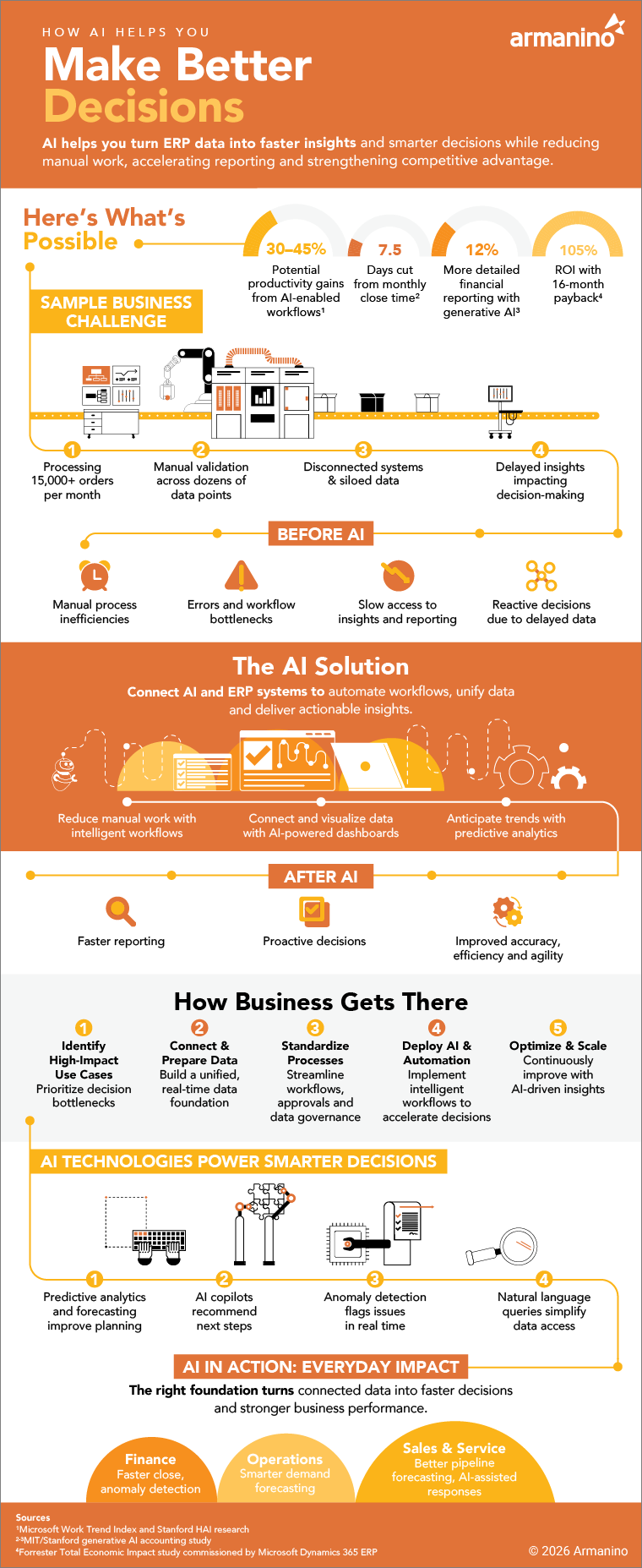
Want to display this infographic on your site? Copy and paste the following code. Be sure to include attribution to armanino.com with this graphic.
As your operations grow, so does complexity. You may have new entities, additional business units, more customers, expanded supply chains, acquisitions or global operations. Fast growth often means significant changes to your accounting and finance operations.
You may discover that the systems and workflows that supported you at one stage of growth no longer scale effectively.
AI-enabled ERP platforms are particularly valuable as you grow. They help you:
You can grow without relying entirely on additional administrative overhead to manage complexity.
Traditionally, teams have underused the capacity of their existing ERPs. Lack of training, poor adoption and clumsy implementations drive people to develop workarounds that bypass the ERP altogether.
An ERP is only as valuable as its level of usage.
Modern AI-enabled ERPs are designed for easy use and adoption. Yes, people will still need training. But when your users have a better experience, adoption increases. For example, many of the newer ERPs use a chat interface instead of dashboards.
As growing pains and ERP adoption improve, so does the value of your ERP and ROI.
For the last few years, when people talked about AI for business, they focused on automation. True, automation matters, but it’s only part of the story.
The deeper business value comes from agility.
AI-enabled ERP systems help you make decisions faster, adapt to change more effectively and operate with greater confidence in uncertain environments. That capability compounds over time.
When you have stronger visibility and predictive insights, you can:
AI is reshaping ERP into a strategic business platform rather than simply an operational system.
It’s a distinction that matters because your competitive advantage today is increasingly tied to how quickly you can interpret information and respond effectively.
Many leaders still view AI as something emerging or experimental. Don’t be one of them. The leaders getting ahead with AI in ERP are working with the embedded AI functionality to enhance speed and decision support, improving data foundations and reimagining workflows. Learn how our ERP consulting experts can help you act now, not later.
To learn more about modernizing your ERP, getting a project back on track or setting your business up for sustainable growth, schedule your complimentary ERP consultation.