
Choosing the right back-office support is one of the most important decisions finance leaders face. This guide will help you:
CFOs and COOs are navigating one of the most complex business environments in decades. Labor costs keep rising, skilled talent is scarce and compliance requirements are multiplying. The result? Month-end closes slip, audit readiness becomes a scramble, and strategic priorities like forecasting and scenario planning get pushed aside.
This guide is designed to help you navigate these challenges by exploring the key considerations for selecting a managed services provider. Consider the experiences of "George Anderson," a fictional character who represents a combination of our real-life clients and expresses the challenges many real-life CFO s face.
George Anderson is the CFO of a $700 million manufacturer. As the firm prepared for a major expansion, George’s job was to guide the company toward its next milestone — $1 billion in revenue — through disciplined capital allocation and operational efficiency. Instead, he found himself fighting back-office fires.
Do you feel George’s pain? The weight of endless expectations, the relentless strain on back offices stretched to their limits — it’s a story all too familiar to finance leaders. You carry the burden of delivering flawless results in a world that never stops demanding more.
Imagine that George’s controller, tax director and lead financial analyst all resign within weeks of one another, throwing the finance function into chaos. Recruiting replacements take time and come with high costs, while interim contractors provide only temporary relief. George’s remaining staff work long hours to keep the books current, but management reporting and analysis still falls behind.
George realizes that relying solely on in-house teams can present challenges. Building and retaining a skilled internal team requires significant investment in recruiting, training and retention. When resources are stretched thin, critical processes can fall behind, making it harder to meet business goals.
To stabilize operations, George turns to a traditional outsourcing firm. Initially, it helps — invoices are processed, payrolls met, reporting catches up. For routine, transactional tasks, outsourcing proves to be a reliable solution.
However, as George’s needs grow, he realizes he needs more than just execution. He needs strategic insights and a collaborator who could align with his growth strategy. While outsourcing provided valuable support, it wasn’t designed to meet these evolving demands. New requests require additional scopes of work, which adds costs and delays. The fractional outsourcing team, balancing multiple clients, sometimes struggles to provide timely assistance for urgent needs.
Both in-house and outsourcing models have their strengths, but George realized he needed a collaborator who could think strategically, align with his long-term goals and take ownership of outcomes. That’s when he began exploring a managed services model.
George knew he needed a strategic advisor who would own outcomes, not just tasks — and who could deliver decision-ready insights so he could focus on growth. What George really wanted was someone he could trust to think the way he did, take shared accountability for success and manage day-to-day operations so he could concentrate on guiding the company toward its $1 billion goal.
It was time to aim higher and find a firm capable of delivering that level of engagement. That search led him to consider a managed services engagement model that goes beyond basic outsourcing by embedding expertise, technology and process support under a single, predictable agreement.
A managed services provider functions as an extension or in place of an internal team, sharing accountability for outcomes and aligning priorities with business goals. After speaking with a firm that offered this model, George realized it was exactly what he’d been looking for.
Once he reviewed the provider’s client case studies and results, George quickly saw how a managed services model could transform his back office. Ideas started flowing: he could consolidate accounting and tax under one roof and add IT managed services to manage applications and monitor the data center. He could even extend the model into HR and finance operations for a fully integrated back-office solution.
The experiences of “George Anderson” highlight the power of a comprehensive managed services approach. But like our example CFO, you may be wondering which delivery model is right for your organization. Before making a switch, it's worth taking a step back to compare your options and understand what each truly offers.
Building an internal team gives you direct control but comes with high fixed costs and limited scalability. Recruiting, training and retaining qualified talent takes time and resources, especially in a tight labor market. When turnover hits or workloads spike, productivity drops and key processes — like reporting, reconciliations and audit prep — can stall.
Outsourcing is an excellent choice for companies that need to offload routine, well-defined tasks. It shifts staffing responsibilities to a third party, providing access to skilled professionals and global talent pools. For short-term stabilization or specific projects, outsourcing can be a cost-effective solution.
However, outsourcing is typically input-based, meaning you pay for effort, not outcomes. It works best for execution but may not deliver the strategic guidance or continuity needed for long-term growth.
Managed services builds on the strength of outsourcing by adding strategic guidance, accountability and proactive management. Unlike outsourcing, which focuses on tasks, managed services providers align with your business goal and take shared responsibility for outcomes. This scalable, proactive engagement model provides ongoing expertise, advanced technology and standardized processes under a single, predictable agreement, emphasizing long-term success.
Outsourcing and managed services don’t have to be an either-or decision. Many companies use outsourcing for routine tasks while leveraging managed services for strategic initiatives. Together, they create a hybrid approach that balances cost efficiency with long-term value.
Even after asking the right questions, experienced finance leaders can make costly missteps when selecting a managed services provider. In reading this guide, you now are already unlikely to make the mistake of confusing managed services with outsourcing, or fractional support.
Here are some of the other most common traps and how to avoid them:
Once you factor in benefits, payroll taxes, recruiting, onboarding and the cost of turnover, internal headcount often costs 30–50% more than salary alone, making Managed Services a competitive option.
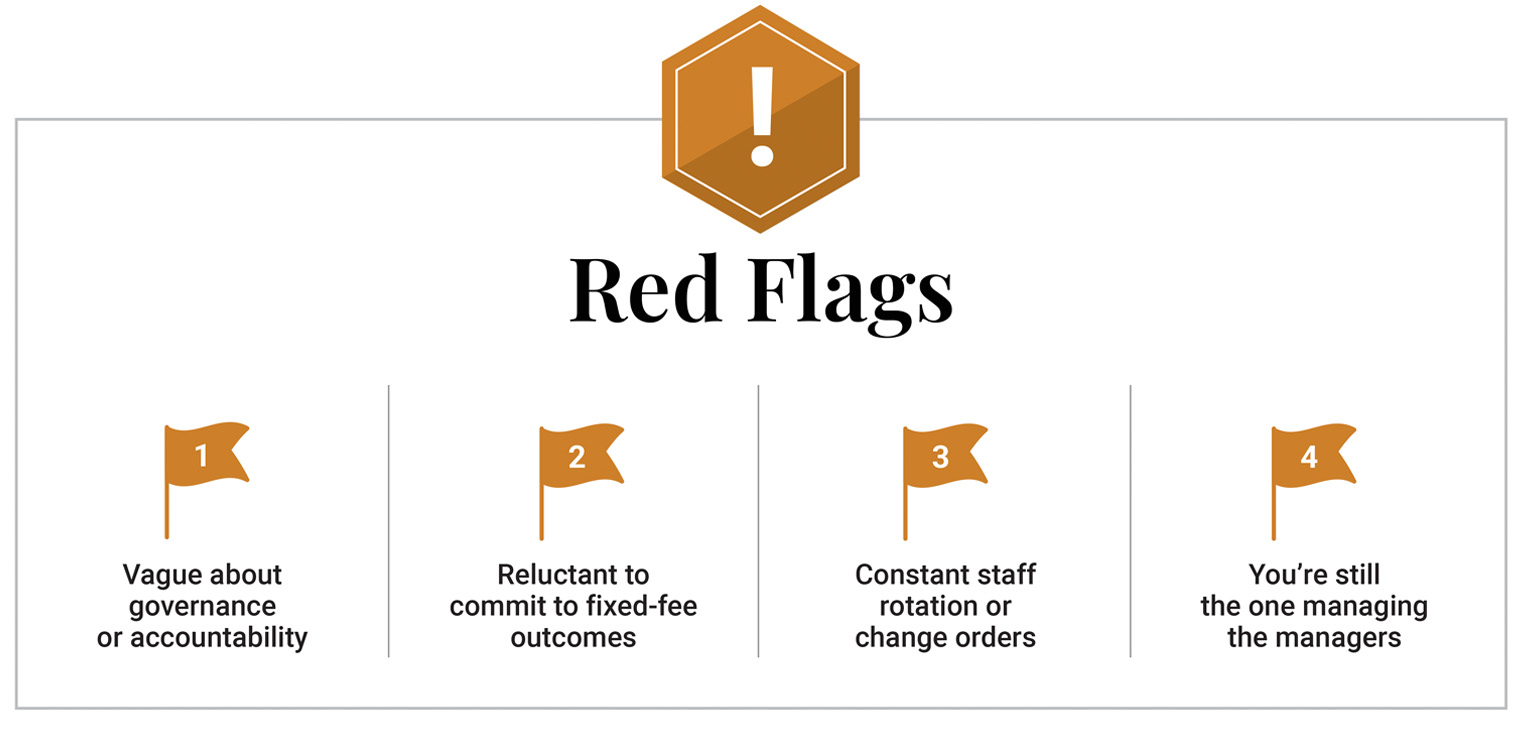
When selecting a managed service provider, every finance leader should examine not just whether they can “do the work,” but their capacity to deliver the right experience. Use this checklist to evaluate whether a managed services provider can truly deliver accountability, insight and long-term value.
Governance & Communication
Accountability & Performance
Team Structure & Continuity
Pricing & Terms
Operational Model & Expertise
The best managed service providers go well beyond transactions; they become trusted members of your team. They lead with insight, own the outcomes alongside you, and continuously improve the functions they manage.
When George reframed his search for back-office support around outcomes and experience, he found a provider who did just that. Together, they rebuilt his finance function into a scalable platform for growth. Close timelines improved, audit readiness became routine, and George finally had the space and insights to focus on strategic decisions.
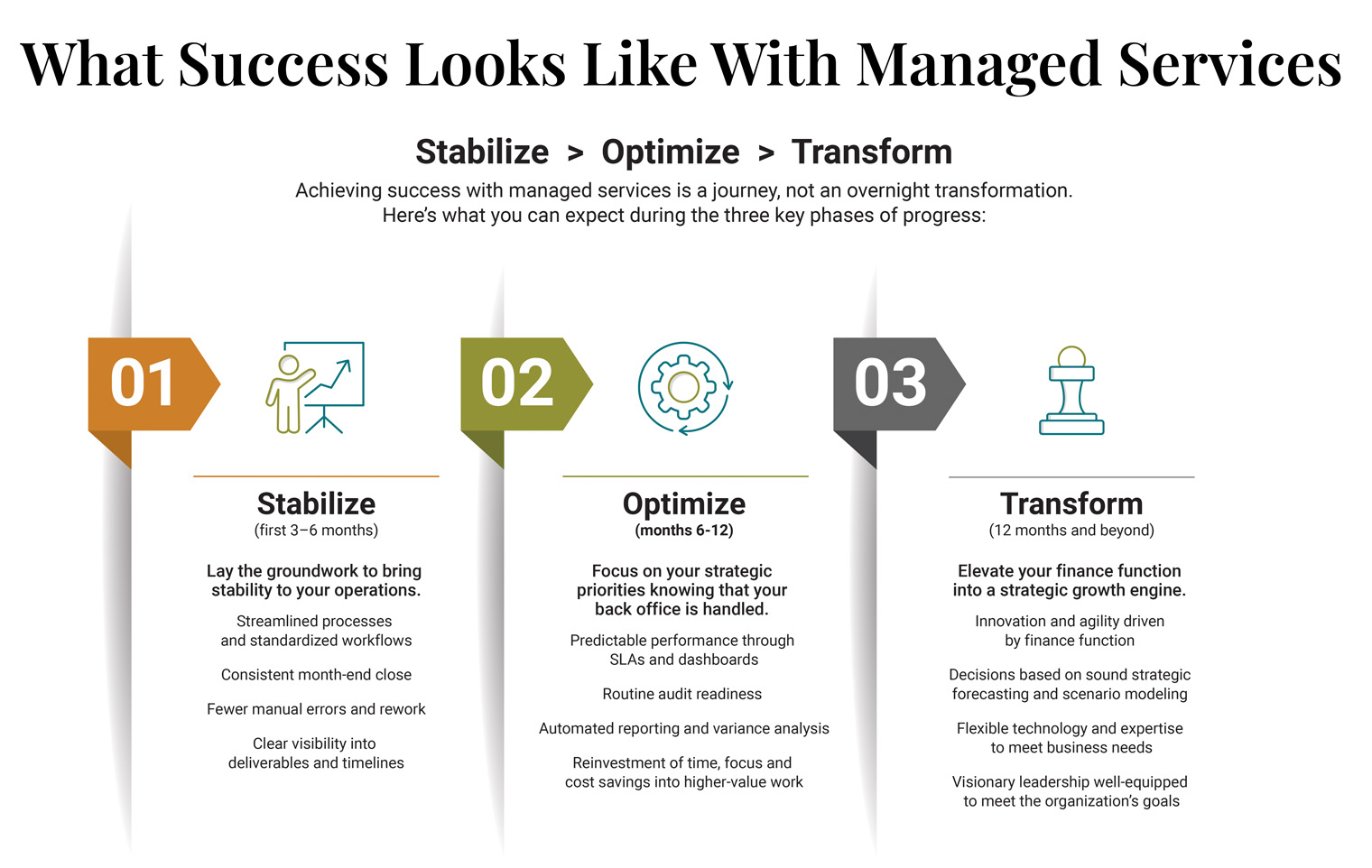
Is back-office chaos stalling your company’s progress? Managed services can help you reclaim your time, restore control and refocus on long-term growth. Explore our CFO Evolution Guide to see how tech-enabled managed services supports the transition to a platform CFO — empowering you to drive strategy, scalability and innovation. Learn how our Managed Services experts can customize a back-office plan to help you achieve your vision.
Take our self-evaluation to see how prepared you are for the next era of finance leadership. Discover how your skills and strategy stack up against the Platform CFO benchmark—and uncover insights to help you lead with confidence.