
Opportunity Zones Tax Credits
Article

Opportunity Zones

March 18, 2026

What you need to know about OZ tax benefits.

Why it matters

Opportunity zones (OZ) reward long-term capital commitments in distressed communities with significant tax advantages — but the One Big Beautiful Bill Act (OBBBA) legislation is reshaping the rules:

  • The OBBBA made the OZ programs permanent but reset zone designations, meaning investments made before and after 2027 are subject to different benefits.
  • If you act before Dec. 31, 2026, you can still lock in capital gains deferral and potential exclusions under the current framework.
  • Understanding how Qualified Opportunity Funds work, including hold periods, rural area bonuses and 180-day investment windows can significantly reduce your tax liability.

What Is an Opportunity Zone?

Opportunity zones (OZ) are federally designated low-income areas that offer special tax incentives for investment in qualified local businesses and property.

Also known as a “Qualified Opportunity Zone” or QOZ, the designation was created by the 2017 Tax Cuts and Jobs Act to encourage long-term, private investment in economically distressed communities. While the program was originally set to expire in 2028, it was made permanent by “The One Big Beautiful Bill Act” (OBBBA) which was signed into law in July 2025. This retains many of the tax advantages but also has new requirements and considerations starting in 2026.


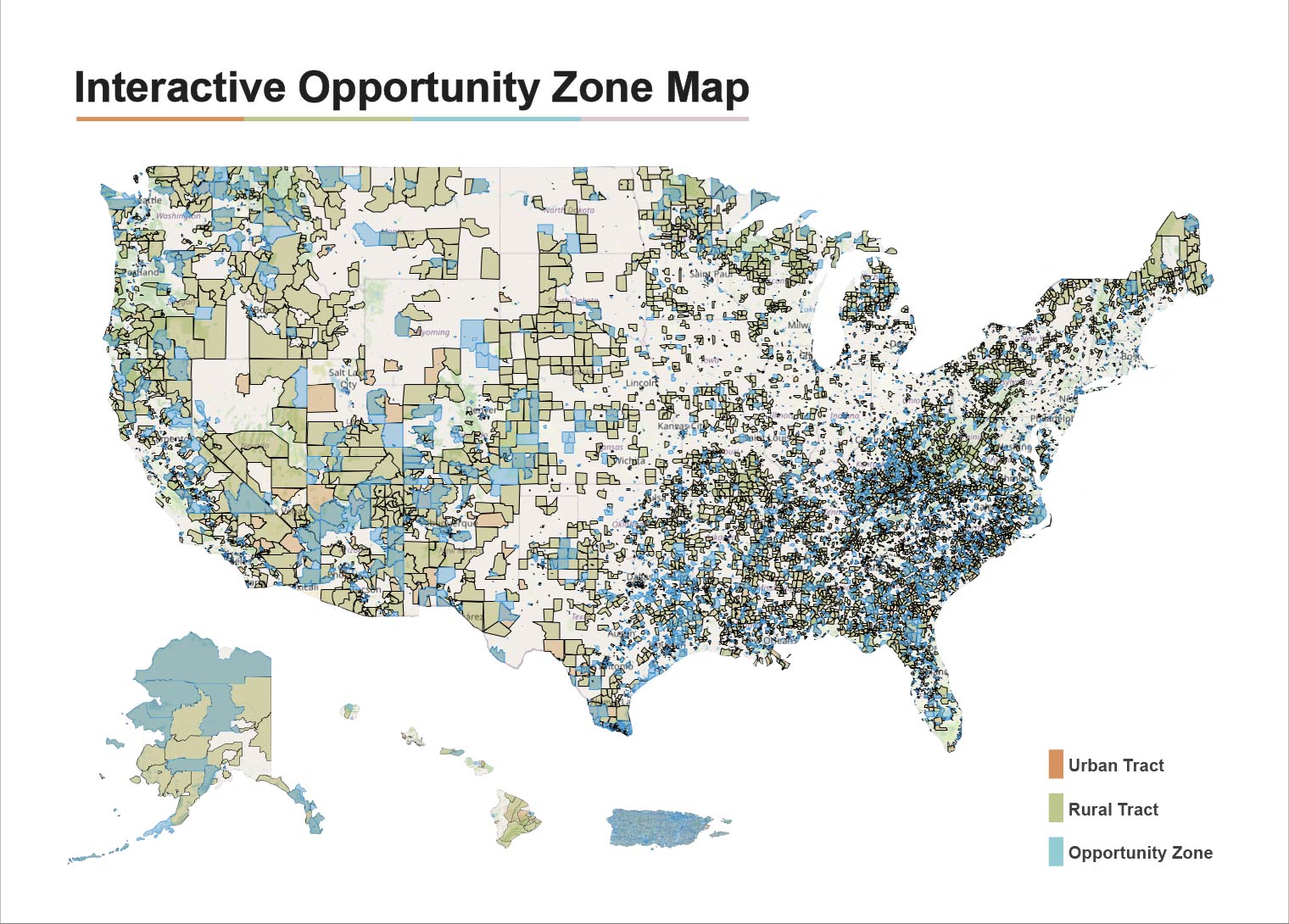
Where Are Opportunity Zones in the United States?

As of the original 2017 designation, there were 8,746 opportunity zones in the United States and U.S. Territories. There are about 7,000 under the changes enacted by the OBBBA that affect zone eligibility and designation. For a closer look, explore the interactive Opportunity Zone Map1 and stay informed by subscribing to map updates.

At the end of 2026, the OBBBA will sunset the current set of OZs and create a new set of zones starting in Jan. 2027. The newly revised tax benefits, including the capital gains deferral, will only be available after Jan. 1, 2027, for investments made in the newly designated zones.

The OBBBA also has stricter eligibility criteria and narrows the set of census tracts eligible for designation as OZs. There are several notable changes:

  • It eliminated the provision allowing governors to designate census tracts contiguous to low-income communities.
  • The “low-income community” designation has been reduced from 80% of the statewide median income to 70%.
  • Puerto Rico no longer has a special designation that made nearly all of its census tracts available. Now only 25% of eligible census tracts may be designated as OZs.
  • The OBBBA mandates governors choose new zones every ten years to create a rotating system of opportunity in the OZs.
  • The overall changes are expected to reduce the total number of OZs by 20%, resulting in approximately 7,000 zones.

See the official HUD Opportunity Zone website for additional detailed resources.

Several states, including California, Massachusetts, Mississippi, North Carolina and Washington state, do not conform to the federal opportunity zone tax rules and offer their own state-level tax breaks. So, investors from these states only benefit from the federal program. In those states that conform to the federal opportunity zone tax rules, the applicable capital gains tax for both federal and state is deferred and avoided.


How Opportunity Zones Work

Opportunity zones offer tax benefits to individuals or corporations who reinvest short-term or long-term capital gains in a Qualified Opportunity Fund (QOF). To receive the maximum tax benefit, the gains must remain invested in the QOF for at least 10 years.

Opportunity zone designations were originally set to expire at the end of 2028, with investors having until 2047 to dispose of their QOF investment. However, the OBBBA made the opportunity zone program permanent.

Claiming OZ benefits requires two IRS forms. Form 8997 must be attached to the investor's tax return each year the investment remains in a QOF. IRS Form 8949 is required in the first year to report the capital gain and flag the deferral election. Beneficiaries of trusts or estates also file Schedule K-1 (Form 1041).


How You Can Benefit from an Opportunity Zone

The OZ program delivers three distinct tax advantages — each more powerful the longer capital stays invested.

Temporary deferral of taxes on capital gains

Investors don’t pay tax on deferred gains until Dec. 31, 2026, or when they dispose of the asset, whichever is earlier. For investments made after Jan. 1, 2027, in the newly designated zones, investors defer the original gain until the Qualified Opportunity Fund (QOF) is disposed of or the inclusion event occurs.

Tax-free growth after 10 years

When an investment is kept in a QOF for at least 10 years, there is no tax on capital gains that accrued after the investment.

Basis step-up benefits

There is now a new tiered structure for investments in rural areas and non-rural areas.

“Rural areas” are defined in Notice 2025-50 as any area other than a city or town with a population greater than 50,000 and excluding urbanized areas contiguous to such cities. Those who invest in rural OZs and hold them for five years receive up to a 30% reduction in the capital gains tax owed on the deferred gains. As of IRS Notice 2025-50, 3,309 OZs were located entirely in a rural area.

Those who invest in non-rural OZs and hold them for five years receive up to a 10% reduction in the capital gains tax owed on the deferred gains.

Enhanced benefits for rural area improvements

The OBBBA also offers additional benefits for property improvements in qualified, entirely rural OZs. As of July 4, 2025, the improvement threshold was reduced from 100% to 50%. Under the new threshold, investors must invest an amount equal to 50% of the building's cost basis — excluding land — rather than the previous 100% requirement. That lower bar makes it significantly easier to qualify existing rural buildings as opportunity zone property.


Qualified Opportunity Funds (QOFs)

A QOF is a corporation or partnership structured specifically to deploy capital into opportunity zones. That 90% threshold is calculated by averaging asset percentages at the midpoint and final day of the QOF's tax year.

A QOF must file IRS Form 8996 with its annual federal income tax return. While QOFs can directly own a Qualified Opportunity Zone (QOZ) business property or invest in qualified opportunity zone businesses, they cannot invest in another QOF.

Qualified Opportunity Fund investment: Tangible property

Tangible property owned by a QOF must meet these requirements to qualify:

  • Used in a trade or business in a qualified opportunity zone.
  • Acquired by purchase from an unrelated party after Dec. 31, 2017.
  • Either its original use in the zone must commence with the QOF or it must be substantially improved.
  • Tangible property is generally valued for the 90% test based on its undepreciated cost. However, if a QOF has an Applicable Financial Statement (AFS), the value of the property as reported on the AFS may be used by the OZ Fund for its 90% test.

Qualified Opportunity Fund Investment: Leased property

Leased property used by a QOF must also be considered in its 90% test, even though leases and leased property are generally not valued or reported as assets for tax purposes.

The value is determined by discounting the present value of future lease payments using the IRS Applicable Federal Rate (AFR). Once the lease is initially valued (when it is entered into), its value remains unchanged for all subsequent testing dates. If a QOF has an Applicable Financial Statement that reports leased property as assets, the value can be used if it is also used in calculating the value of tangible property owned.

Equity investment vs. debt

An investment in a QOF must be an equity interest, including preferred stock or a partnership interest with special allocations and debt instruments do not qualify. However, investors can use a QOF investment as collateral for a loan.

The 180-day deferral rule

Investors have 180 days from the triggering gain event to roll proceeds into a QOF — missing that window forfeits the deferral benefit.

To qualify for deferral, investors must invest in a QOF within 180 days of the sale or exchange that generates the gain or the date that the gain would otherwise be recognized for federal income tax purposes.

For gains from pass-through entities (a partnership, trust/estate or S corporation), the rules generally allow either the entity or the partners, shareholders or beneficiaries to elect deferral.

The 12-month reinvestment period

A QOF has 12 months to reinvest its proceeds from the return of capital or the sale/disposition of property in a qualified opportunity zone property. If the QOF’s reinvestment plans are delayed due to a federally declared disaster, it has an additional 12 months to reinvest.

Fund testing

Qualified Opportunity Funds are tested by the IRS semiannually for rule compliance. The initial testing date is on the last day of the sixth month after the fund’s taxable year begins and the second testing date is on the last day of the fund’s taxable year.


Qualified Opportunity Zone Businesses

For a trade or business to be a qualified opportunity zone business, at least 70% of its owned or leased tangible property must be qualified opportunity zone business property, and it must comply with specific business tax rules.

What is a Qualified Opportunity Zone business property?

A qualified opportunity zone business property is a tangible property acquired by a QOF after 2017 and used in a trade or business.

Qualified Opportunity Zone Business rules

To be designated as a qualified opportunity zone business, it must meet all of the following tests:

  • The business generates at least 50% of its total gross income from the active conduct of a qualifying trade or business.
  • The business uses a substantial part (at least 40%) of its intangible (non-physical) property in the active conduct of any such business.

The business is not a private or commercial golf course, country club, massage parlor, hot tub facility, suntan facility, racetrack, gambling facility or any store whose principal business is the sale of alcoholic beverages for consumption off premises.


Opportunity Zone Investing: Frequently Asked Questions

Opportunity zone investing offers compelling tax advantages — but the rules governing eligibility, fund structure, and state conformity are nuanced.

What happens to my investment in an existing OZ when zones are redesignated in 2027?

Current OZ designations expire Dec. 31, 2026, with new zones taking effect Jan. 1, 2027, under the OBBBA. Investments made before that deadline retain their tax benefits through the full hold period.

What is the tax difference in investing in a Qualified Opportunity Fund organized as a partnership versus one that’s a Real Estate Investment Trust (REIT)?

The structure matters significantly. Distributions from an opportunity zone REIT are taxed as ordinary income.

How do losses in the initial years of a partnership fund work for investors?

Early-stage losses pass through to investors via Schedule K-1 as passive losses.

How do depreciation and depreciation recapture work in a Qualified Opportunity Fund?

Once you sell your investment, you do not have to pay back tax on that depreciation.

Are refinance distributions taxable?

Refinancing proceeds distributed to investors generate additional basis in the QOF investment and are therefore tax-free. This allows investors to access liquidity from appreciated assets without triggering a taxable event.

When the tax comes due for an investor’s original opportunity zone investment, what happens if they have capital losses from other investments?

Investors can use capital losses harvested between the date of their original OZ investment and Dec. 31, 2026, to offset the deferred gain recognized on their 2026 federal return. Strategic tax-loss harvesting in those intervening years can meaningfully reduce — or eliminate — the tax liability triggered at the deferral deadline.

California is a nonconforming state under federal OZ legislation. How does that affect individual investors in California who invest in opportunity zones there?

On your federal Form 1040, you show the IRS that you’re taking advantage of the opportunity zone program and do not have to pay federal capital gains tax. On your California form, you would have to pay the California capital gains tax on that.

What are the tax implications for individual investors from other states who invest in opportunity zones in California?

If you’re an out-of-state investor investing in a California-based Qualified Opportunity Fund, you will not have to pay your state capital gains tax on that investment, assuming you’re not in one of the few states that do not conform to IRC Section 1400Z-2. Keep in mind that because the property you’re investing in is in California, after that 10-year period, when it’s sold, you would still have to pay state capital gains tax on that. Depending on the size and nature of your investment, you may be eligible for other California Tax Credits.

How do I know an OZ in a rural area qualifies for enhanced benefits?

IRS Notice 2025-50 identifies 3,309 of the current 8,764 QOZs as located entirely within rural areas — and only those entirely rural zones qualify for enhanced benefits. A rural area is defined as any area outside a city or town with a population greater than 50,000 and excluding urbanized areas contiguous to such cities. Investors should verify rural designation before assuming enhanced benefits apply.


Should you invest in an OZ?

With zone redesignations coming in 2027 and the Dec. 31, 2026, deadline approaching, the window to lock in maximum tax benefits is closing. Learn more about how our opportunity zone tax specialists can help you evaluate your investment options, structure your QOF entry, and maximize your capital gains exclusion before the rules change.

Are You Missing Tax Credit Savings?

Armanino has the industry expertise, tax credit experience and track record of customer satisfaction to best advise your tax credit incentive strategy and compliance needs.

Contact us today for a free assessment.
The information contained on this page is for general guidance on matters of interest only. As such, it should not be used as a substitute for consultation with professional accounting, tax, legal or other competent advisers. Before making any decision or taking any action, you should consult an Armanino tax consultant.
1 This interactive Opportunity Zone 2.0 map reflects the eligible population census tracts which may be nominated to be designated as Qualified Opportunity Zones (QOZs) beginning in 2027 as described in Revenue Procedure 2026-14. Not all eligible population census tracts described in Revenue Procedure 2026-14 and shown on this Opportunity Zone 2.0 map will be designated as QOZs. The CEOs of each state, the District of Columbia, and the United States territories (States) must nominate to the Secretary of the Treasury (Treasury) a certain portion of their State’s eligible tracts to be designated as QOZs by October 28, 2026, at the latest. Treasury has until December 28, 2026, at the latest, to certify those nominations and designate the nominated tracts as QOZs.
Data for the interactive opportunity zone map derived from these resources:
  • Opportunity Zone 1.0: published by CDFI Fund in 2018
  • Likely eligible tracts for designation as Opportunity Zone 2.0 based on criteria from One Big Beautiful Bill Act (OBBBA) and the following data sources:
    • 2024 Census tracts and demographic data
    • 2023 American Community Survey data on tract poverty and state median family income (MFI)